Last-Mile Delivery: Choosing Between Micro-Drones and Sidewalk Bots
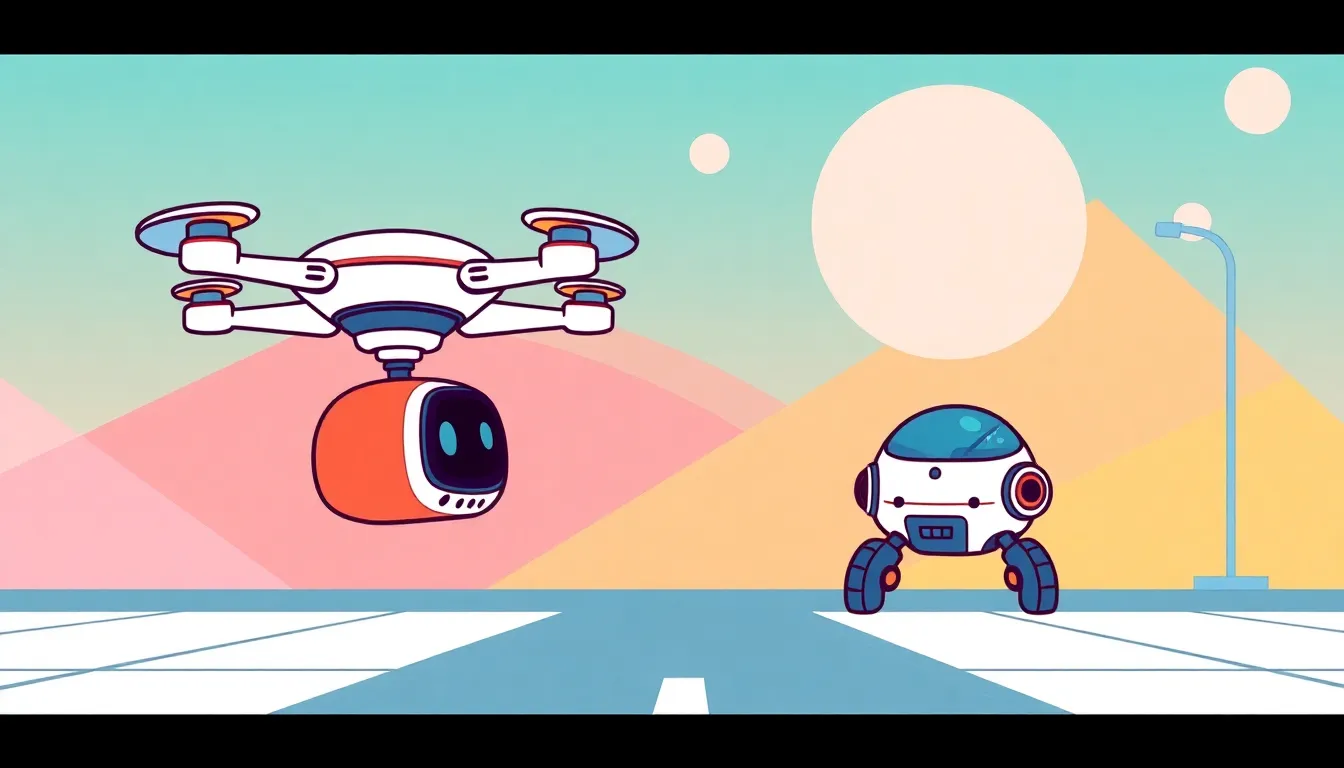
Urban delivery services face a choice: airborne micro-drones or ground-level sidewalk robots. Each offers distinct speed, cost, and regulatory trade-offs; selecting the right option requires aligning capabilities with local constraints, operations, and business goals.
- TL;DR: Drones win on speed and range where airspace and payload allow; sidewalk bots excel in dense pedestrian areas and complex access points.
- Hybrid approaches often deliver the best ROI by matching tech to route segments and use cases.
- Run a staged pilot with clear safety metrics and stakeholder roles before scaling.
Frame the problem and objectives
Define the core delivery problem: target service time (e.g., 30-minute express, same-day, or scheduled), typical package sizes and weights, density of delivery points, and geographic features (high-rises, parks, waterways).
Set measurable objectives: cost per delivery, average delivery time, safety incidents per 10k trips, customer satisfaction, and carbon footprint. Clarify constraints such as operating hours, urban design, and brand experience.
Quick answer — 1-paragraph summary
Micro-drones are best where line-of-sight, payload limits (light goods), and permissive airspace enable rapid point-to-point deliveries; sidewalk bots are preferable in dense, regulated pedestrian environments, carrying heavier loads and interacting with customers at curbside. Hybrid solutions combining drones for radial speed and bots for final-meter delivery often maximize service coverage and minimize regulatory friction.
Compare micro-drones vs sidewalk bots: capabilities and costs
Below are side-by-side capability and cost considerations to help decide which tech fits your use case.
| Dimension | Micro-drones | Sidewalk bots |
|---|---|---|
| Typical payload | 0.5–5 kg | 5–50+ kg |
| Range per sortie | 5–30 km (line-of-sight) | 10–50 km per charge (slow) |
| Average speed | 30–80 km/h | 3–6 km/h |
| Capital cost (unit) | $5k–$50k | $2k–$20k |
| Operational complexity | High (airspace, BVLOS, weather) | Medium (sidewalk navigation, battery swaps) |
| Customer interaction | Remote drop or tethered lowering | On-site pickup, locker integration |
Cost per delivery depends heavily on density. In low-density suburbs, drones can be cost-effective due to speed; in dense downtowns, robots benefit from multi-stop efficiency. Consider maintenance, charging/refueling infrastructure, insurance, and skilled operator costs.
Assess legal, safety, and infrastructure constraints
Regulations and public acceptance are often the limiting factor. Map these constraints early.
- Airspace rules: BVLOS (beyond visual line of sight) authorizations, altitude limits, geofencing near airports, and privacy laws.
- Sidewalk and pedestrian laws: municipal bans or curb access restrictions, liability for collisions, and ADA compliance.
- Infrastructure needs: charging/landing stations, secure micro-hubs, and communications coverage (LTE/5G).
- Safety requirements: detect-and-avoid systems, redundant communications, anti-tamper mechanisms, and emergency landing/stop protocols.
Example: a city may permit drone deliveries in industrial zones but restrict flights over dense residential areas, while allowing delivery bots only if they yield to pedestrians and meet speed caps.
Design operational workflows and routing strategies
Design workflows that reflect real-world constraints and customer expectations.
- Hub-and-spoke vs distributed micro-hubs: place micro-hubs to minimize first-mile ground transfers and maximize drone range efficiency.
- Route segmentation: use drones for long radial legs, bots for curb-to-door last meters, and human couriers for complex access (stairs, locked lobbies).
- Scheduling: batch deliveries into multi-stop runs for bots; sequence drone sorties to optimize battery and airspace usage.
- Exception handling: define clear handoffs for failed drops, weather cancellations, and customer-not-home scenarios.
Routing example: a suburban micro-hub launches drones to apartment building rooftops where bots/concierge complete the final delivery, or drones lower packages to designated drop zones near sidewalks.
Integrate tech: sensors, comms, autonomy, and backend
Reliable delivery requires integrated stacks: vehicle-level autonomy, resilient connectivity, and operational backends.
- Sensors: LiDAR + stereo cameras for perception; ultrasonic or radar for close-proximity obstacle avoidance.
- Comms: redundant links (cellular 4G/5G + private LTE + mesh). Low-latency links for critical telemetry.
- Autonomy: path planning, fail-safe behaviors, geofencing, and dynamic rerouting triggered by hazards.
- Backend: real-time fleet management, geospatial routing engine, regulatory flight logs, and customer notifications.
Short code example for a routing decision rule:
// pseudo-rule: choose vehicle type
if (distance > 2.5 km && payload <= 5kg && airspace_permits) choose = "drone";
else if (curb_access_clear && payload <= 50kg) choose = "bot";
else choose = "human";
Pilot plan: metrics, phasing, and stakeholder roles
Run a multi-phase pilot to de-risk operations before scaling.
- Phase 0 — Feasibility: regulatory checks, site surveys, stakeholder alignment.
- Phase 1 — Controlled trials: limited routes, manual oversight, focus on safety metrics.
- Phase 2 — Live pilot: customers invited, automated routing, collect performance & cost data.
- Phase 3 — Scale-up: refine SOPs, staff training, expand geographies.
| KPI | Target (example) |
|---|---|
| On-time rate | >95% |
| Cost per delivery | Reduce by 20% vs baseline |
| Safety incidents | <0.1 per 10k trips |
| Customer satisfaction (CSAT) | >4.5/5 |
Stakeholder roles: operations manager, airspace compliance officer, field technicians, customer service, municipal liaison, and data analyst.
Common pitfalls and how to avoid them
- Overlooking local regulation: consult municipal authorities early; secure waivers and define operational envelopes.
- Underestimating environmental factors: add weather-triggered SOPs and margin in range calculations.
- Poor integration with last-meter access: design lockers, concierge handoffs, or bot handoffs to avoid failed deliveries.
- Single-point comms failure: deploy redundant connectivity and local autonomy to handle blackouts.
- Ignoring public perception: run community outreach, transparent safety reports, and visible branding to build trust.
Decision framework: choose drones, bots, or a hybrid
Use a simple scoring model across five dimensions: speed, payload fit, regulatory difficulty, unit economics, and customer experience. Score 1–5 and sum to guide a decision.
| Dimension | Drone | Bot |
|---|---|---|
| Speed | 5 | 2 |
| Payload fit | 2 | 4 |
| Regulatory difficulty | 2 | 4 |
| Unit economics | 3 | 3 |
| Customer experience | 3 | 4 |
Interpretation: a close total suggests hybrid deployment—use drones for long legs and bots for dense neighborhoods or last meters.
Implementation checklist
- Define service goals and target KPIs.
- Map regulatory and infrastructure constraints.
- Select vehicle types per route segment using the decision matrix.
- Build micro-hub and charging/landing infrastructure.
- Develop fail-safe autonomy and redundant comms.
- Run phased pilot; collect KPIs and public feedback.
- Iterate and scale with clear SOPs and stakeholder governance.
FAQ
-
Q: Which is cheaper per delivery?
A: It depends on density—drones are cheaper for sparse, radial routes; bots beat drones in dense, multi-stop areas. -
Q: Can drones and bots work together?
A: Yes—hybrids use drones for long-range legs and bots/humans for final-meter delivery, reducing regulatory exposure. -
Q: How do you handle bad weather?
A: Define weather thresholds, automate hold/cancel logic, and provide fallback via ground couriers or bots. -
Q: What are typical pilot durations?
A: 3–12 months depending on regulatory approvals and geographic complexity. -
Q: When should we choose humans over robots?
A: For complex access (locked lobbies, high-value items, heavy payloads) or when regulations prohibit automation.